by Henry David Thoreau






Filter comments by group
0 Comments on the whole Page
4 Comments on paragraph 1
0 Comments on paragraph 2
0 Comments on paragraph 3
1 Comment on paragraph 4
-
Posted in: Panel of Experts
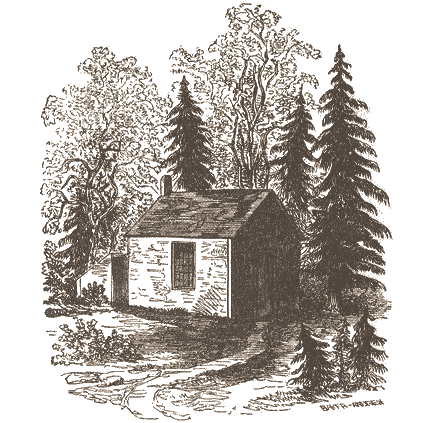
The drawing of T’s cabin was made by his sister Sophia, an amateur artist. T himself complained of it, “Thoreau would suggest a little alteration, chiefly in the door, in the wide projection of the roof at the front; and that the bank more immediately about the house be brought out more distinctly” (Sanborn, 1917, 338). Sanborn adds, “He must have noticed that her trees were firs and pines, with a few deciduous tress that did not then grow there.” Ellery Channing thought it a “feeble caricature.” Other contemporary drawings of the cabin may be found in Meltzer and Harding (144-5).

1 Comment on paragraph 5
-
Posted in: Panel of Experts
[to wake my neighbors up]
The epigraph is quoted from the second chapter of W. It is omitted from many modern editions, and unfortunately so, for it sets the mood for the whole book. Broderick (1954) points out how this awakening and morning theme is a basic image carried throughout W. A possible source for T’s idea is Orestes Brownson’s statement in his Boston Quarterly Review in 1839 that he “aimed to startle, and made it a point to be as paradoxical and extravagant as he could.”
0 Comments on paragraph 6
Recent Comments on this Page
-
Posted in: General Discussion
Caroline Crimmins
Paragraph 1: Last semester I took Professor Cooper’s English 368 Connections in Recent Literature: Unplugged and ParaDigitial class and examined the relationship between books and technology. On the first day of class, we talked about how Thoreau was actually much closer to civilization than it seems in his writing. Although I cannot find the original map that I saw on my first day of class, this map also demonstrates that even though Thoreau was somewhat “tucked away” he was still decently close to civilization. He talks about occasionally catching people off the train to hear the town’s gossip, something he cannot resist. He also mentions occasionally wandering into town for the human connection that he sometimes yearned for. I believe that this is an interesting point to bring into his first chapter “Economy” because he talks to the reader about how he builds his own house that is meant to be so distant from society but in reality it is quite the opposite. This relates strongly to technology today because even people that claim they want to be distant from the innovations we are creating as a society are still somehow connected to technology in some way. Technology has a huge influence on our society and there is almost no way of having total seclusion from the world or from the devices we have invented and are still working on today.
-
Posted in: Panel of Experts
In his new book, Cryptic Subtexts in Literature and Film: Secret Messages and Buried Treasure (New York: Routledge, 2019), Steven F. Walker offers a new interpretation of Walden’s 1854 subtitle, “Life in the Woods.” It is well known that that subtitle was hardly original, having appeared in several publications prior to the publication of Walden, including an article of that name by Charles Lane which appears in the final issue of The Dial. Walker grants that Thoreau may have used the title “ironically,” that is, “as a vigorous rejoinder to the thesis of Lane’s Dial essay” (13). More intriguing, however, is Walker’s argument that Thoreau may have associated “life in the woods” with a phase of life known in Hindu as “vanaprastha” (literally translated as “life in the woods”)—“the third stage of life—that of the solitary, contemplative hermit living in the forest on the outskirts of the village—as described in The Laws of Manu” (14) which Thoreau read in Emerson’s library in 1840. “Such a new framing,” Walker says, “certainly provides a new perspective on Thoreau’s life-in-the-woods enterprise, which, for all its Yankee originality, also can be seen as a spiritual retreat based on an ancient Hindu paradigm of the stages of life” (16).
-
Posted in: General Discussion
Is there any possibility of Thoreau borrowing from the Christian tradition and positing “the woods” as a corollary of “wilderness”, where the demons (in us) are often portrayed and living? To reach one’s “higher self”, one must wake up inwardly to those elements that lead the soul (psychological and emotional state) astray.
-
Posted in: Panel of Experts
The drawing of T’s cabin was made by his sister Sophia, an amateur artist. T himself complained of it, “Thoreau would suggest a little alteration, chiefly in the door, in the wide projection of the roof at the front; and that the bank more immediately about the house be brought out more distinctly” (Sanborn, 1917, 338). Sanborn adds, “He must have noticed that her trees were firs and pines, with a few deciduous tress that did not then grow there.” Ellery Channing thought it a “feeble caricature.” Other contemporary drawings of the cabin may be found in Meltzer and Harding (144-5).
-
Posted in: Panel of Experts
[WALDEN; OR, LIFE IN THE WOODS]
Although the first edition gives the title Walden; or, Life in the Woods, on March 4, 1862, two months before he died, T wrote to his publishers, Ticknor & Fields, asking them to omit the subtitle in a new edition. They complied with this request, although it has rarely been followed since. Paul (75) suggests that T may have dropped the subtitle because he feared his audience was taking it too literally and thus missing the more important philosophy permeating the book. T could have derived the subtitle from his friend Charles Lane’s essay “Life in the Woods” in the Dial (IV, 1844, 415) or from John S. Williams, “Our Cabin; or, Life in the Woods” in the October 1843 American Pioneer (DeMott), but not from the then popular The Adirondack; or Life in the Woods, by J.T. Headley (New York, 1849), which did not appear until after T had used the subtitle in an advertisement for W in the back pages of the first edition of A Week. For a comprehensive study of the types of books on which T based the structure of W, see Linck Johnson. For a discussion of the organic structure of W, see Lane (1960). Kurtz is one o the most straightforward analyses of W’s style.
-
Posted in: Panel of Experts
[to wake my neighbors up]
The epigraph is quoted from the second chapter of W. It is omitted from many modern editions, and unfortunately so, for it sets the mood for the whole book. Broderick (1954) points out how this awakening and morning theme is a basic image carried throughout W. A possible source for T’s idea is Orestes Brownson’s statement in his Boston Quarterly Review in 1839 that he “aimed to startle, and made it a point to be as paradoxical and extravagant as he could.”


Most liked comments on this page
-
Posted in: Panel of Experts
The drawing of T’s cabin was made by his sister Sophia, an amateur artist. T himself complained of it, “Thoreau would suggest a little alteration, chiefly in the door, in the wide projection of the roof at the front; and that the bank more immediately about the house be brought out more distinctly” (Sanborn, 1917, 338). Sanborn adds, “He must have noticed that her trees were firs and pines, with a few deciduous tress that did not then grow there.” Ellery Channing thought it a “feeble caricature.” Other contemporary drawings of the cabin may be found in Meltzer and Harding (144-5).
-
Posted in: Panel of Experts
[WALDEN; OR, LIFE IN THE WOODS]
Although the first edition gives the title Walden; or, Life in the Woods, on March 4, 1862, two months before he died, T wrote to his publishers, Ticknor & Fields, asking them to omit the subtitle in a new edition. They complied with this request, although it has rarely been followed since. Paul (75) suggests that T may have dropped the subtitle because he feared his audience was taking it too literally and thus missing the more important philosophy permeating the book. T could have derived the subtitle from his friend Charles Lane’s essay “Life in the Woods” in the Dial (IV, 1844, 415) or from John S. Williams, “Our Cabin; or, Life in the Woods” in the October 1843 American Pioneer (DeMott), but not from the then popular The Adirondack; or Life in the Woods, by J.T. Headley (New York, 1849), which did not appear until after T had used the subtitle in an advertisement for W in the back pages of the first edition of A Week. For a comprehensive study of the types of books on which T based the structure of W, see Linck Johnson. For a discussion of the organic structure of W, see Lane (1960). Kurtz is one o the most straightforward analyses of W’s style.
-
Posted in: Panel of Experts
In his new book, Cryptic Subtexts in Literature and Film: Secret Messages and Buried Treasure (New York: Routledge, 2019), Steven F. Walker offers a new interpretation of Walden’s 1854 subtitle, “Life in the Woods.” It is well known that that subtitle was hardly original, having appeared in several publications prior to the publication of Walden, including an article of that name by Charles Lane which appears in the final issue of The Dial. Walker grants that Thoreau may have used the title “ironically,” that is, “as a vigorous rejoinder to the thesis of Lane’s Dial essay” (13). More intriguing, however, is Walker’s argument that Thoreau may have associated “life in the woods” with a phase of life known in Hindu as “vanaprastha” (literally translated as “life in the woods”)—“the third stage of life—that of the solitary, contemplative hermit living in the forest on the outskirts of the village—as described in The Laws of Manu” (14) which Thoreau read in Emerson’s library in 1840. “Such a new framing,” Walker says, “certainly provides a new perspective on Thoreau’s life-in-the-woods enterprise, which, for all its Yankee originality, also can be seen as a spiritual retreat based on an ancient Hindu paradigm of the stages of life” (16).
-
Posted in: General Discussion
Is there any possibility of Thoreau borrowing from the Christian tradition and positing “the woods” as a corollary of “wilderness”, where the demons (in us) are often portrayed and living? To reach one’s “higher self”, one must wake up inwardly to those elements that lead the soul (psychological and emotional state) astray.
-
Posted in: Panel of Experts
[to wake my neighbors up]
The epigraph is quoted from the second chapter of W. It is omitted from many modern editions, and unfortunately so, for it sets the mood for the whole book. Broderick (1954) points out how this awakening and morning theme is a basic image carried throughout W. A possible source for T’s idea is Orestes Brownson’s statement in his Boston Quarterly Review in 1839 that he “aimed to startle, and made it a point to be as paradoxical and extravagant as he could.”
Recent Comments in this Text
-
Posted in: ENGL 340 S26 Geneseo
I love this connection between chapters, @livikelly. I think there’s no question that in “Conclusion,” Thoreau lays particular emphasis on the importance of mental independence and inner exploration. I’d say that idea pervades Walden all the way through, though. In “Where I Lived, and What I Lived For” paragraph 13, for example, he writes:
Where I lived was as far off as many a region viewed nightly by astronomers. We are wont to imagine rare and delectable places in some remote and more celestial corner of the system, behind the constellation of Cassiopeia’s Chair, far from noise and disturbance. I discovered that my house actually had its site in such a withdrawn, but forever new and unprofaned, part of the universe.
In other words, he only had to be a short physical distance from his neighbors to experience solitude, because the experience is as much a function of mind as of matter.
-
Posted in: General Discussion
@courtneygoodwin: I think this is a great point about the different ways that Thoreau references animals in Walden. Including their Latin genus-species names makes most sense when they’re objects of his attention as a naturalist and less sense when he’s referencing them to illustrate general truths like those he offers in this conclusion.
-
Posted in: ENGL 340 S26 Geneseo
[? Be rather the Mungo Park, the Lewis and Clark and Frobisher, of your own streams and oceans; explore your own higher latitudes,—]
This is a similar sentiment to Thoreau’s remarks in Where I Lived, And What I Lived For about the railroads. In WILAWILF, Thoreau resists the invention of the railroad, rather proposing that if everyone boycotts the train, then it will no longer run. I think at the center of this argument is really Thoreau trying to emphasize the power of the individual to forge his own path, which is the central message of this paragraph in Conclusion.
-
Posted in: ENGL 340 S26 Geneseo
Thoreau’s whole thing about “beaten tracks” in Conclusion reminds me of what he says earlier in “Where I Lived, and What I Lived For.” Back there, he talks about how people fall into routines without thinking and end up living those “quiet desperation” lives. Here, he uses the literal path he wore in the woods as a symbol for the mental habits we slip into. It’s like he’s circling back to the same idea but showing it in a new way, not just society pushing us into ruts, but us doing it to ourselves. And when he says he wants to “go before the mast,” it connects to his earlier push to live deliberately and see the world clearly instead of hiding below deck. It is the same message, just with a fresh angle.
-
Posted in: ENGL 340 S26 Geneseo
In this paragraph, Thoreau’s imagery of migration and movement echoes his earlier voice in “Where I Lived, and What I Lived For,” when he emphasizes the importance of breaking free from our routines that can limit human potential. I think that his earlier chapters focus more on physically removing yourself from society to live more intentionally. Thoreau expands that same idea by suggesting that the real limitation isn’t necessarily physical, but mental. By comparing migrating animals to humans who feel stuck in social roles (like a town clerk), Thoreau slightly shifts his earlier argument, suggesting that the ways we limit ourselves can be more restrictive than any physical boundaries. This helps him strengthen his main idea that real freedom isn’t just about changing your surroundings, it is about changing the ways you think about all the possibilities.
-
Posted in: ENGL 340 S26 Geneseo
[ Leave a comment on paragraph 4 30 I left the woods for as good a reason as I went there. Perhaps it seemed to me that I had several more lives to live, and could not spare any more time for that one. It is remarkable how easily and insensibly we fall into a particular route, and make a beaten track for ourselves]
Henry David Thoreau explains here that he left the woods and returned to normal life for a similar reason as why he went there. He felt as though his time at Walden Pond had come to an end and that it would have been a disservice to himself and humanity to not embark on a new chapter. This reminds me of language he ahs used throughout the whole book and especially in the beginning in Where I lived and What I lived for as he is explaining why he went to the woods in the first place. The similar language Thoreau has used throughout the whole book and especially in the ending emphasizes his wish to live life deliberately and focus on the true meaning of life without all the distractions of modern society. By him saying he left Walden pond because he knew it was time to start a new chapter of life and discovery, he is living the philosophy that he preaches which is one of experience and true meaning.
-
Posted in: General Discussion
Some of the language and mention of animals in this first paragraph of the conclusion remind me of Thoreau’s discussion and observation of animals in the chapters Former Inhabitants and Winter Visitors, along with Winter Animals. In the Winter Animals chapter, for example, Thoreau often talks about the beauty of simply observing the animals around you, and he was incredibly patient in doing so. The animals discussed in these chapters consisted of local wildlife that Thoreau saw on most days. However, in this chapter he broadens the wildlife he discusses, mentioning bison in Colorado, and even giraffes in Africa later in the chapter. This is helping to express his message that anyone, anywhere, can choose to do what he did. Broaden their views of the world by looking inside themselves and appreciating the small things of life, such as nature, rather than chasing a materialistic life. Along with this, a difference within this chapter is that when referring to various animals, Thoreau does not include their scentific name in italics as he did in previous chapters. Perhaps this is because he is not observing these animals specifically, or that he simply did not want that in the final chapter.
-
Posted in: ENGL 340 S26 Geneseo
The language used in this last sentence, specifically when he discusses “Only that day dawns to which we are awake,” “There is more day to dawn. The sun is but a morning star,” is very familiar to that of earlier sections like “Where I Lived, and What I Lived For.” In that previous section, he urges people to live deliberately and awake and to make the most of every moment. This is discussing the same thing, as it is saying that awakening is not a one-time act but an ongoing process of renewal. I love that his last paragraph connects to other parts of the book because it makes it feel full circle.
-
Posted in: ENGL 340 S26 Geneseo
[I called on the king, but he made me wait in his hall, and conducted like a man incapacitated for hospitality. There was a man in my neighborhood who lived in a hollow tree. His manners were truly regal. I should have done better had I called on him.]
This line is incredibly reminiscent of a scene noted earlier in Walden, in House-Warming 7. There, the line was…
[A house whose inside is as open and manifest as a bird’s nest, and you cannot go in at the front door and out at the back without seeing some of its inhabitants; where to be a guest is to be presented with the freedom of the house, and not to be carefully excluded from seven eighths of it, shut up in a particular cell, and told to make yourself at home there,—in solitary confinement. Nowadays the host does not admit you to his hearth, but has got the mason to build one for yourself somewhere in his alley, and hospitality is the art of keeping you at the greatest distance].
In both lines, the point Thoreau is trying to make is very much the same. In seems that today’s society is flawed. We are focused on wealth and progress as the most important thing, rather than morality or connection. In both cases, someone is pictured as being welcomed into a mansion, but ignored. In this section, Thoreau points out that a man who lived in a hollow tree has more manners. He has less, so his values are better.
-
Posted in: ENGL 340 S26 Geneseo
In this paragraph, Thoreau reiterates what he said earlier in “Where I Lived, and What I Lived For” about living deliberately. In both chapters, he’s pushing the idea that people should stop just going through the motions and actually choose how they want to live. But here in the “Conclusion,” it feels more directed at the reader, like he’s trying to motivate us instead of just reflecting on his own experience. It kind of turns his earlier ideas into a challenge, making it feel more personal and motivating toward readers.


Posted in: Panel of Experts
[WALDEN; OR, LIFE IN THE WOODS]
Although the first edition gives the title Walden; or, Life in the Woods, on March 4, 1862, two months before he died, T wrote to his publishers, Ticknor & Fields, asking them to omit the subtitle in a new edition. They complied with this request, although it has rarely been followed since. Paul (75) suggests that T may have dropped the subtitle because he feared his audience was taking it too literally and thus missing the more important philosophy permeating the book. T could have derived the subtitle from his friend Charles Lane’s essay “Life in the Woods” in the Dial (IV, 1844, 415) or from John S. Williams, “Our Cabin; or, Life in the Woods” in the October 1843 American Pioneer (DeMott), but not from the then popular The Adirondack; or Life in the Woods, by J.T. Headley (New York, 1849), which did not appear until after T had used the subtitle in an advertisement for W in the back pages of the first edition of A Week. For a comprehensive study of the types of books on which T based the structure of W, see Linck Johnson. For a discussion of the organic structure of W, see Lane (1960). Kurtz is one o the most straightforward analyses of W’s style.
Posted in: General Discussion
Is there any possibility of Thoreau borrowing from the Christian tradition and positing “the woods” as a corollary of “wilderness”, where the demons (in us) are often portrayed and living? To reach one’s “higher self”, one must wake up inwardly to those elements that lead the soul (psychological and emotional state) astray.
Posted in: Panel of Experts
In his new book, Cryptic Subtexts in Literature and Film: Secret Messages and Buried Treasure (New York: Routledge, 2019), Steven F. Walker offers a new interpretation of Walden’s 1854 subtitle, “Life in the Woods.” It is well known that that subtitle was hardly original, having appeared in several publications prior to the publication of Walden, including an article of that name by Charles Lane which appears in the final issue of The Dial. Walker grants that Thoreau may have used the title “ironically,” that is, “as a vigorous rejoinder to the thesis of Lane’s Dial essay” (13). More intriguing, however, is Walker’s argument that Thoreau may have associated “life in the woods” with a phase of life known in Hindu as “vanaprastha” (literally translated as “life in the woods”)—“the third stage of life—that of the solitary, contemplative hermit living in the forest on the outskirts of the village—as described in The Laws of Manu” (14) which Thoreau read in Emerson’s library in 1840. “Such a new framing,” Walker says, “certainly provides a new perspective on Thoreau’s life-in-the-woods enterprise, which, for all its Yankee originality, also can be seen as a spiritual retreat based on an ancient Hindu paradigm of the stages of life” (16).
Posted in: General Discussion
Caroline Crimmins
Paragraph 1: Last semester I took Professor Cooper’s English 368 Connections in Recent Literature: Unplugged and ParaDigitial class and examined the relationship between books and technology. On the first day of class, we talked about how Thoreau was actually much closer to civilization than it seems in his writing. Although I cannot find the original map that I saw on my first day of class, this map also demonstrates that even though Thoreau was somewhat “tucked away” he was still decently close to civilization. He talks about occasionally catching people off the train to hear the town’s gossip, something he cannot resist. He also mentions occasionally wandering into town for the human connection that he sometimes yearned for. I believe that this is an interesting point to bring into his first chapter “Economy” because he talks to the reader about how he builds his own house that is meant to be so distant from society but in reality it is quite the opposite. This relates strongly to technology today because even people that claim they want to be distant from the innovations we are creating as a society are still somehow connected to technology in some way. Technology has a huge influence on our society and there is almost no way of having total seclusion from the world or from the devices we have invented and are still working on today.